
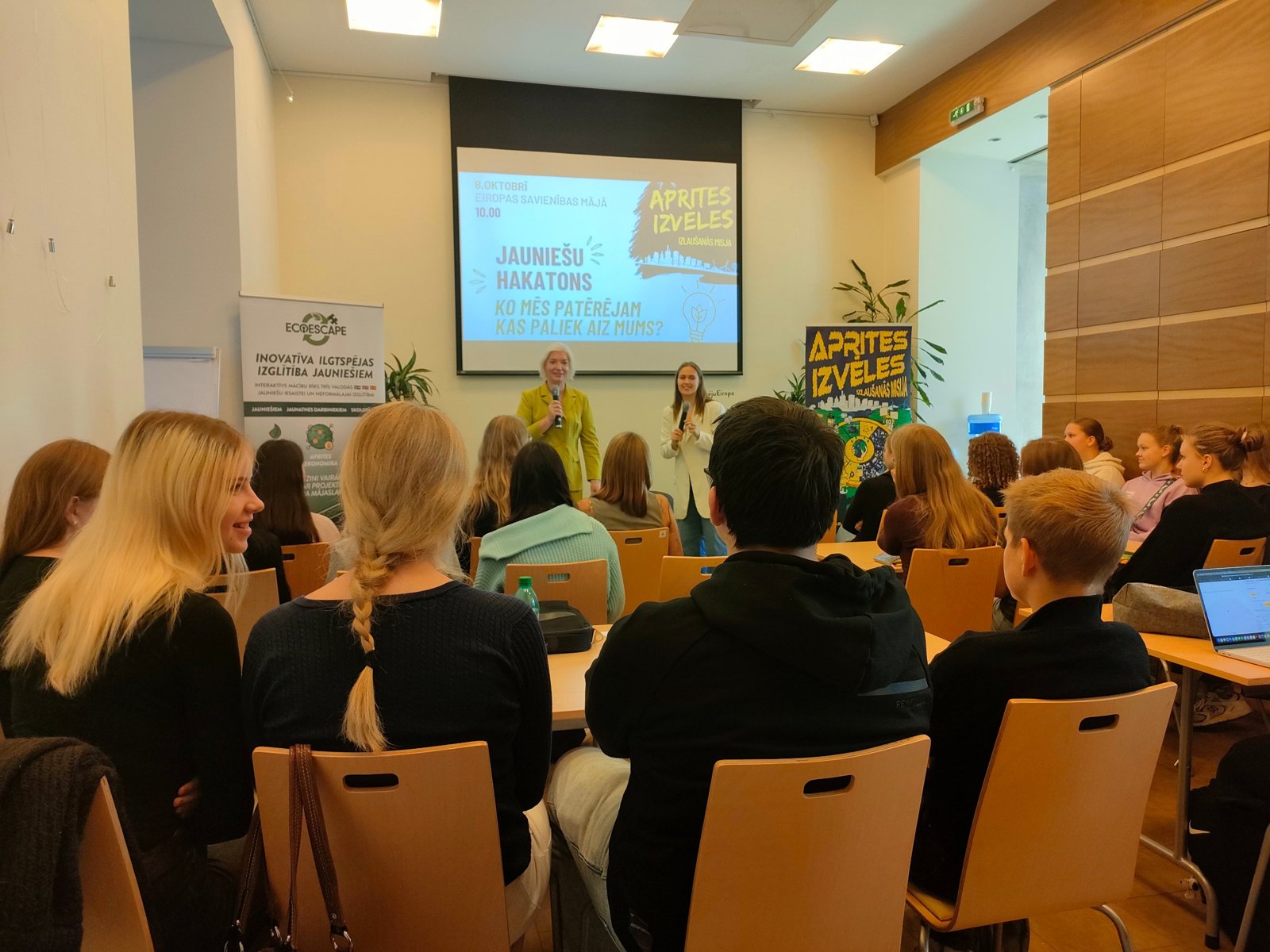
On 8 October, INDEED Projects travelled to Riga to see first-hand the good practices of our Latvian partners, the Latvian Sustainable Procurement Association, and to learn from their experience with sustainability in their local context, so that we can improve our joint project, EcoEscape.
This time we took part in the youth hackathon What do we consume and what do we leave behind? (in Latvian, Jauniešu hakatons: Ko mēs patērējam, kas paliek aiz mums?), held at the European Union House in Riga. About 30 young people came together to tackle current sustainability challenges, supported by expert mentors.
Experts and young people around the same table
The day included a panel discussion, The role of the circular economy and education in a sustainable future, with:
- Rudīte Vesere, Deputy State Secretary for environmental and sustainability policy at the Ministry of Climate and Energy;
- Ieva Kalniņa, coordinator and international project manager at the Riga Energy Agency;
- Daniels Trukšāns, head of the Eco-Schools programme (Ekoskolu programma);
- Inese Pelša, chair of the Latvian Sustainable Procurement Association and EcoEscape coordinator, who moderated.
It was followed by the talk New points of view on the way from problem to solution (Jauni skatu punkti ceļā no problēmas līdz risinājumam), given by Vita Brakovska, PhD, of the ZINIS association (Biedrība ZINIS).
From ideas to projects
After these sessions, the young people developed their projects in groups. At the end they presented them to a jury made up of:
- Inese Pelša, chair of the jury and of the Latvian Sustainable Procurement Association;
- Natālija Cudečka-Puriņa, professor at the School of Business and Finance Technologies of the University of Latvia;
- Jolanta Malnace, lead expert in the implementation department of the LIFE integrated project at the Ministry of Climate and Energy.
It was a well-rounded day that brought together the views of sustainability experts with the fresh ideas and new perspectives of young people, who threw themselves into developing their projects. We are taking many of these lessons home to EcoEscape, the digital escape game on sustainability, the circular economy and responsible consumption that we are developing with our Latvian partners.